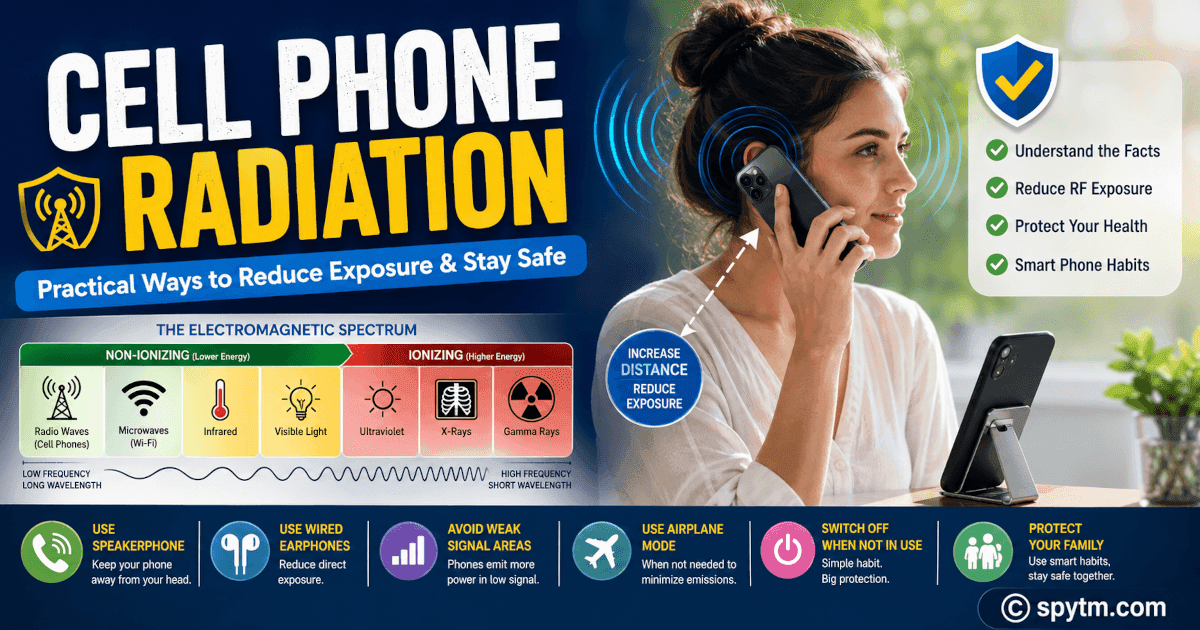
Mobile phones have become an essential part of daily life. We use them for calls, messages, social media, online banking, navigation, entertainment, work, and education. While smartphones make life easier, many people are concerned about cell phone radiation and its potential effects on health.
You may have heard claims that mobile phones cause cancer, damage the brain, or create serious health problems. At the same time, you may have also heard that mobile phones are completely harmless. The truth lies somewhere in between.
Mobile phones emit radiofrequency (RF) energy, a type of non-ionizing radiation used to transmit signals. Scientists have been studying the health effects of RF exposure for decades. Although current research has not established that normal cell phone use directly causes diseases such as brain cancer, many health organizations recommend taking simple precautions to reduce unnecessary exposure.
This guide explains what cell phone radiation is, what science currently says about it, practical ways to reduce exposure, common myths, and safe mobile phone habits for everyday use.
What Is Cell Phone Radiation?
Cell phones communicate with nearby cellular towers using radiofrequency (RF) signals.
RF energy belongs to the non-ionizing radiation category, which is different from ionizing radiation such as:
X-rays
Gamma rays
Nuclear radiation
Ionizing radiation has enough energy to damage DNA directly.
Mobile phone RF signals do not have enough energy to damage DNA in the same way.
However, researchers continue to study whether long-term exposure may have other biological effects.
Understanding the Electromagnetic Spectrum
The term "radiation" often sounds alarming because many people associate it with X-rays or radioactive materials. However, not all radiation is the same.
Cell phones use radiofrequency (RF) energy, which belongs to the non-ionizing portion of the electromagnetic spectrum. Non-ionizing radiation does not have enough energy to directly damage DNA like ionizing radiation can.
The electromagnetic spectrum ranges from very low-energy radio waves to extremely high-energy gamma rays.
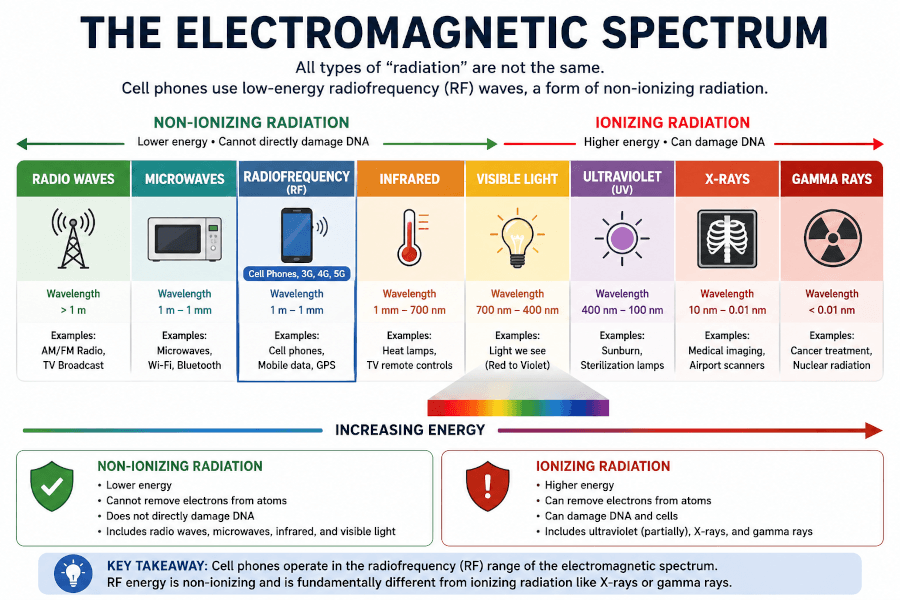
Electromagnetic Spectrum Overview
Electromagnetic Spectrum (Illustrative Energy Levels)
Higher values indicate higher energy. Cell phone RF signals are located in the non-ionizing portion of the spectrum.
0306090120Radio Waves (Cell...MicrowavesInfraredVisible LightUltravioletX-RaysGamma Rays
Non-Ionizing vs Ionizing Radiation
Non-Ionizing Radiation | Ionizing Radiation |
|---|---|
Radio waves | X-rays |
Cell phone signals | Gamma rays |
Wi-Fi signals | Nuclear radiation |
Bluetooth signals | Medical imaging radiation |
Lower energy | Much higher energy |
Cannot directly damage DNA | Can directly damage DNA |
Why This Matters
A common misunderstanding is that all forms of radiation are equally dangerous. In reality, cell phones use low-energy radiofrequency signals that are fundamentally different from X-rays used in hospitals or gamma rays produced by radioactive materials.
This does not mean researchers have stopped studying mobile phone exposure. However, understanding where mobile phone signals sit on the electromagnetic spectrum helps put the discussion into proper scientific context.
How Mobile Phones Emit Radiation
Your phone emits RF energy when:
Making calls
Receiving calls
Sending text messages
Using mobile data
Streaming videos
Uploading files
Connecting to cellular networks
Generally, the phone emits more power when:
Signal strength is weak
Downloading large files
Uploading videos
Moving between cell towers
What Does Science Say About Cell Phone Radiation?
Current scientific evidence has not proven that normal mobile phone use causes cancer.
Major health organizations continue to monitor research on the topic.
What About 5G Radiation?
One of the most common concerns today is whether 5G technology is more dangerous than older cellular networks.
Current scientific evidence does not show that 5G poses unique health risks compared to previous mobile network generations.
Like 3G and 4G networks, 5G uses non-ionizing radiofrequency energy, which does not have enough energy to directly damage DNA in the way that X-rays or gamma rays can.
Some 5G frequencies are higher than those used by older networks. However, these higher-frequency signals generally penetrate the human body less deeply and are mostly absorbed near the skin's surface.
Researchers continue to study long-term exposure, but current international safety standards apply to 5G devices and infrastructure as well.
4G vs 5G Comparison
Feature | 4G | 5G |
|---|---|---|
Radiation Type | Non-ionizing | Non-ionizing |
DNA Damage Capability | No | No |
Typical Speed | High | Very High |
Tissue Penetration | Deeper than some 5G bands | Generally shallower |
Current Safety Standards | Yes | Yes |
What We Know
Mobile phones emit RF energy.
RF energy decreases rapidly as distance increases.
Using speakerphone or headsets can reduce exposure to the head.
Weak signal areas may cause phones to increase transmission power.
What We Don't Know
Scientists are still studying:
Very long-term exposure over decades
Heavy lifetime mobile phone use
Potential effects on children
Emerging technologies and future networks
Because research continues, many experts recommend a precautionary approach.
Why Distance Matters
One of the easiest ways to reduce exposure is to increase the distance between your body and your phone.
RF energy drops significantly as distance increases.
The Inverse-Square Law: Why a Few Inches Make a Big Difference
One of the simplest ways to reduce RF exposure is to increase the distance between your body and your phone.
This is because radiofrequency energy follows a principle in physics called the inverse-square law. In simple terms, the strength of RF energy decreases rapidly as the distance from the source increases.
For example:
Moving a phone a few inches away from your head can significantly reduce exposure.
Doubling the distance from the source can reduce the intensity to roughly one-quarter of its original level.
Increasing the distance even further reduces exposure dramatically.
This is why using speakerphone, placing the phone on a desk, or using wired earphones can be effective ways to reduce direct RF exposure while still using your device normally.
Quick Example
Distance from Phone | Relative Exposure |
|---|---|
1 inch | 100% |
2 inches | ~25% |
4 inches | ~6% |
8 inches | ~1.5% |
Note: Actual exposure varies depending on phone model, signal strength, and network conditions.
Example
Holding a phone directly against your ear exposes you to more RF energy than:
Using speakerphone
Using wired earphones
Holding the phone several inches away
This is why distance is considered one of the most effective ways to reduce exposure.
12 Practical Ways to Reduce Cell Phone Radiation Exposure
1. Use Speakerphone Whenever Possible
Speakerphone keeps the device away from your head.
Benefits
Increases distance
Reduces direct exposure
Comfortable for longer calls
Best For
Home use
Office use
Private environments
2. Use Wired Earphones or Headsets
Wired earphones allow you to keep the phone away from your body.
Advantages
Greater distance from the head
Comfortable during long conversations
Reduces the need to hold the phone
Real-World Example
Instead of holding your phone against your ear during a 30-minute conversation, place the phone on a table and use wired earphones.
3. Send Messages Instead of Long Calls
Text messages generally require less continuous transmission than lengthy voice calls.
Good Situations for Texting
Quick updates
Confirmations
Scheduling appointments
However, avoid excessive screen time and maintain healthy viewing habits.
4. Avoid Long Calls in Weak Signal Areas
When signal strength is poor, your phone may increase transmission power to maintain the connection.
Watch for Heat and Rapid Battery Drain
A practical sign that your phone may be working harder than usual is excessive heat or unusually fast battery drain.
When signal strength is weak, your phone often increases its transmission power to maintain communication with nearby cellular towers.
This can result in:
Faster battery drain
Increased device temperature
Poor call quality
Reduced network performance
Common Situations
Elevators
Underground parking garages
Basements
Remote rural areas
Moving vehicles
If your phone becomes unusually warm while struggling to maintain a signal, consider waiting until coverage improves before making lengthy calls.
Real-World Example
Imagine you're traveling through a rural area with only one signal bar. Your phone continuously increases its transmission power to stay connected. As a result, you may notice:
Faster battery drain
Device warming up
Intermittent call quality
In contrast, a phone with full signal strength usually requires less transmission power to maintain the same connection.
Examples
Elevators
Underground parking
Rural locations
Remote highways
If possible, wait until you have better coverage.
5. Avoid Keeping Your Phone Against Your Body All Day
Many people carry phones:
In pants pockets
Shirt pockets
Bras
Waistbands
Instead:
Use a handbag
Use a backpack
Place it on a desk
Keep it in a jacket pocket when practical
6. Download Content Before Traveling
Streaming requires constant communication with cellular towers.
Before traveling:
Download music
Download videos
Download maps
This reduces continuous cellular activity.
7. Use Airplane Mode When Connectivity Is Not Needed
Airplane Mode disables most wireless transmissions.
Useful situations:
Sleeping
Reading downloaded content
Traveling on flights
Using the device as a camera
8. Avoid Sleeping with Your Phone Next to Your Head
Many people sleep with phones:
Under pillows
Beside the bed
Next to their heads
A better option:
Place it on a table several feet away
Use Do Not Disturb mode
Use Airplane Mode if appropriate
9. Limit Phone Use for Young Children
Children may use smartphones for:
Education
Entertainment
Communication
Encourage:
Balanced screen time
Speakerphone use
Hands-free communication
This helps reduce exposure and promotes healthy technology habits.
10. Choose Areas With Strong Signal Strength
A strong signal allows the phone to communicate more efficiently.
Strong Signal Indicators
Full signal bars
Stable connection
Clear call quality
Weak Signal Indicators
Frequent call drops
Slow mobile data
One or two signal bars
11. Reduce Unnecessary Wireless Connections
Many devices continuously transmit signals through:
Cellular networks
Wi-Fi
Bluetooth
Disable connections you are not using.
For example:
Turn off Bluetooth when unused
Disconnect unused devices
12. Follow Manufacturer Safety Instructions
Every smartphone includes RF exposure information.
Manufacturers provide:
Safety guidelines
Recommended carrying distances
Usage instructions
Review the documentation that comes with your device.
Understanding SAR (Specific Absorption Rate)
SAR stands for Specific Absorption Rate.
It measures the maximum amount of RF energy absorbed by the body under testing conditions.
Important Note
A lower SAR value does not automatically mean a safer phone.
Real-world exposure depends on:
Signal strength
Usage habits
Distance from the body
Network conditions
SAR should be viewed as one factor rather than the only factor.
Cell Phone Radiation Myths vs Facts
Myth | Fact |
|---|---|
Mobile phones definitely cause cancer | Current evidence has not proven this |
Radiation-blocking stickers eliminate radiation | Many products lack strong scientific support |
Airplane Mode still emits full radiation | Airplane Mode significantly reduces wireless transmissions |
Only expensive phones are safe | Safety standards apply across approved devices |
Speakerphone offers no benefit | Increasing distance reduces exposure |
Comparison of Different Calling Methods
Method | Distance from Head | Exposure Reduction |
|---|---|---|
Phone Against Ear | Very Close | Lowest |
Bluetooth Headset | Moderate | Better |
Wired Earphones | Good | Higher |
Speakerphone | Excellent | Highest |
Common Mistakes People Make
Sleeping With the Phone Under a Pillow
This can increase heat buildup and is generally not recommended.
Making Long Calls in Poor Signal Areas
Weak coverage may cause the phone to work harder.
Believing Unverified Products
Many products claim to:
Block radiation
Neutralize radiation
Eliminate RF energy
Always verify claims from credible sources.
Keeping Phones in Tight Pockets All Day
Consider storing devices in bags or placing them on nearby surfaces when practical.
Ignoring Screen Time
For many people, excessive screen time may be a more immediate concern than RF exposure.
Pros and Cons of Reducing Cell Phone Exposure
Pros | Cons |
|---|---|
Encourages healthier phone habits | Requires some lifestyle adjustments |
May reduce RF exposure | Speakerphone isn't suitable everywhere |
Can reduce screen dependency | Wired accessories add extra items to carry |
Promotes mindful technology use | Some precautions may be inconvenient |
Easy and low-cost to implement | Not all situations allow hands-free use |
Real-World Examples
Example 1: Office Worker
Rahul spends several hours daily on work calls.
Instead of holding the phone to his ear all day, he uses wired earphones and places the phone on his desk.
This increases distance and improves comfort.
Example 2: Frequent Traveler
Priya often travels between cities.
Before trips she downloads:
Maps
Music
Movies
This reduces continuous streaming and unnecessary mobile data usage.
Example 3: Student
Arun studies online using a smartphone.
Instead of keeping the phone beside his pillow overnight, he charges it on a table several feet away.
Frequently Asked Questions
What is cell phone radiation?
Cell phone radiation refers to radiofrequency (RF) energy used by phones to communicate with cellular towers.
Do mobile phones cause cancer?
Current scientific evidence has not proven that normal mobile phone use causes cancer, but research continues.
Does speakerphone reduce exposure?
Yes. Increasing distance between your body and the phone can reduce RF exposure.
Is Bluetooth safer than holding a phone to your ear?
Bluetooth devices generally keep the phone farther away from your head, which can reduce direct exposure.
Should I sleep with my phone next to me?
Many experts recommend placing the phone a short distance away rather than directly next to your head.
Does Airplane Mode reduce radiation?
Yes. Airplane Mode disables most wireless transmissions.
What is SAR?
SAR stands for Specific Absorption Rate, a measurement used to estimate RF energy absorption under testing conditions.
Do radiation-blocking stickers work?
Many such products do not have strong scientific evidence supporting their claims.
Final Thoughts
Cell phones are an important part of modern life, and there is currently no conclusive evidence that normal smartphone use causes serious health problems. However, if you want to reduce your exposure to radiofrequency energy, simple habits such as using speakerphone, using wired earphones, avoiding long calls in weak signal areas, and keeping your phone away from your body when possible can help.
The most practical approach is not fear, but awareness. By understanding how mobile phones work and following sensible usage habits, you can enjoy the benefits of modern technology while minimizing unnecessary exposure and maintaining healthier digital habits.