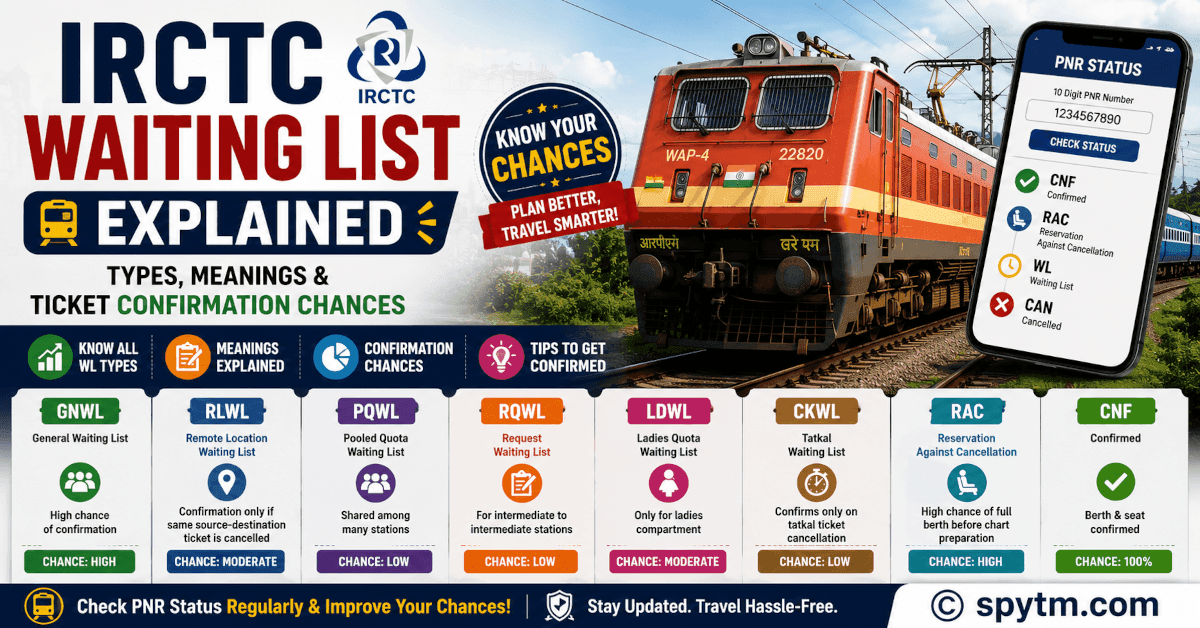
Booking a train ticket through IRCTC is easy, but many passengers get confused when they see terms like WL, GNWL, RLWL, PQWL, RAC, or CKWL on their tickets.
One of the most common questions travelers ask is:
"Will my waiting list ticket get confirmed?"
The answer depends on the type of waiting list, route, passenger demand, quota availability, and ticket cancellations.
In this beginner-friendly guide, you'll learn everything about IRCTC waiting lists, confirmation chances, RAC status, chart preparation, and how to improve your chances of getting a confirmed ticket.
What Is an IRCTC Waiting List?
A waiting list (WL) means your train ticket has been booked successfully, but no berth or seat has been assigned yet.
This happens when all available seats under a quota have already been booked.
Example
Suppose a train has:
500 available berths
500 tickets already booked
If you book next, your ticket may receive:
WL 1This means you are first in the waiting queue.
If one confirmed passenger cancels their ticket, your position moves up.
Eventually, if enough cancellations occur, your ticket may become:
RACor
CNFHow Does Waiting List Confirmation Work?
The Indian Railways reservation system automatically updates ticket status whenever:
A passenger cancels a ticket
Additional coaches are added
Quotas are adjusted
Chart preparation takes place
Ticket Status Progression
A waiting ticket generally moves through the following stages:
WL → RAC → Confirmed (CNF)Not every waiting ticket reaches confirmation.
The probability depends on the type of waiting list.
Understanding PNR Status
PNR stands for:
Passenger Name Record
Every train ticket receives a unique 10-digit PNR number.
Using this number, passengers can check:
Current ticket status
Coach details
Berth number
Waiting list movement
Final chart status
When Should You Check PNR?
Immediately after booking
Few days before journey
After chart preparation
Types of IRCTC Waiting Lists
Let's understand each waiting list type in detail.
GNWL – General Waiting List
GNWL stands for:
General Waiting List
This is the most common waiting list.
When Is GNWL Issued?
GNWL is issued when passengers book:
From the train's originating station
To major destination stations
Confirmation Chances
GNWL has the highest probability of confirmation.
Why?
Because most cancellations occur in General Quota bookings.
Example
Train Route:
Chennai → CoimbatoreBooking:
Chennai → CoimbatoreStatus:
GNWL 25This ticket has a reasonable chance of confirmation depending on demand.
Pros
Highest confirmation chance
RAC available
Priority in allotment
Cons
Popular routes may still remain waitlisted
RLWL – Remote Location Waiting List
RLWL stands for:
Remote Location Waiting List
It applies to passengers traveling between important intermediate stations.
Example
Route:
Chennai → SalemInstead of traveling from the train's starting station.
How RLWL Works
Confirmation occurs mainly when passengers with the same source and destination cancel their tickets.
Confirmation Chances
Generally lower than GNWL.
Pros
Dedicated quota
Cons
Limited cancellations
No RAC benefit in most cases
Lower confirmation probability
RLGN – Remote Location General
RLGN is not a separate waiting list.
It simply indicates that the ticket belongs to a Remote Location quota.
Example
You may see:
RLGN/WL 5This means:
Remote location quota
Waiting list position 5
PQWL – Pooled Quota Waiting List
PQWL stands for:
Pooled Quota Waiting List
This quota is shared among multiple intermediate stations.
Example
Train Route:
Delhi → ChennaiPassenger:
Nagpur → VijayawadaSuch passengers may receive PQWL status.
Confirmation Chances
Generally lower than GNWL.
Why?
Many stations share the same quota.
Pros
Useful for intermediate station passengers
Cons
Lower confirmation rates
Shared quota availability
RQWL – Request Waiting List
RQWL stands for:
Request Waiting List
This applies when:
No General Quota exists
No Remote Quota exists
No Pooled Quota exists
How It Works
Confirmation depends entirely on cancellations from passengers with similar travel segments.
Confirmation Chances
Usually low.
Pros
Allows booking where other quotas are unavailable
Cons
Low confirmation probability
CKWL – Tatkal Waiting List
CKWL stands for:
Tatkal Waiting List
This occurs when Tatkal quota seats are fully booked.
Important Difference
Normal waiting list:
WL → RAC → CNFTatkal waiting list:
CKWL → CNFUsually there is no RAC stage.
Confirmation Happens When
A confirmed Tatkal passenger cancels.
Confirmation Chances
Generally lower than GNWL.
Example
Ticket Status:
CKWL 2You need Tatkal cancellations for confirmation.
Pros
Last-minute booking option
Cons
Lower confirmation probability
Higher fare
LDWL – Ladies Waiting List
LDWL stands for:
Ladies Quota Waiting List
Reserved for women passengers under the ladies quota.
Confirmation Depends On
Ladies quota availability
Ladies quota cancellations
Pros
Reserved quota for women
Cons
Limited berth availability
RAC – Reservation Against Cancellation
RAC is one of the most misunderstood ticket statuses.
What Does RAC Mean?
You are allowed to travel.
You have a reserved seat but may share a berth.
Benefits
Ticket is not cancelled
Travel is guaranteed
High chance of full berth allocation
Example
Status:
RAC 5Before chart preparation:
Another passenger cancels
RAC converts into confirmed berth
Pros
Travel guaranteed
Often converts to full berth
Cons
May initially share a berth
CNF – Confirmed Ticket
CNF stands for:
Confirmed
This means:
Seat allocated
Berth allocated
Travel guaranteed
Example
CNF B2 45 LBMeaning:
Coach B2
Berth 45
Lower Berth
Waiting List Confirmation Comparison
Status | Confirmation Chance |
|---|---|
GNWL | Very High |
RAC | Extremely High |
RLWL | Moderate |
RLGN | Moderate |
PQWL | Low |
RQWL | Low |
CKWL | Moderate to Low |
LDWL | Depends on quota |
What Happens After Chart Preparation?
Chart preparation usually occurs:
About 4 hours before departure
Earlier for some trains
If Ticket Is Confirmed
You receive:
Coach number
Berth number
If Ticket Remains RAC
You can travel.
If Ticket Remains Waitlisted
For e-tickets:
Ticket gets automatically cancelled
Refund processed according to rules
Common Mistakes Travelers Make
Assuming Every WL Ticket Will Confirm
Not all waiting tickets get confirmed.
PQWL and RQWL often have lower chances.
Ignoring Chart Preparation
Many confirmations happen during final charting.
Booking Too Late
Popular routes may fill months in advance.
Confusing RAC With Waiting List
RAC passengers can travel.
Waiting list passengers cannot travel on e-tickets after chart preparation.
Not Checking PNR Regularly
Status can change several times before departure.
Real-World Examples
Example 1: GNWL Success
Passenger books:
GNWL 15Ten days before travel.
After cancellations:
RAC 4Final chart:
CNFExample 2: RLWL Case
Passenger books:
RLWL 8Few cancellations occur.
Final status:
RLWL 3Ticket remains waitlisted.
Example 3: RAC Journey
Passenger receives:
RAC 12No berth before chart preparation.
After boarding:
Another cancellation occurs.
Passenger gets a full berth.
Tips to Improve Ticket Confirmation Chances
Book Early
The earlier you book, the better.
Choose GNWL Routes
GNWL has higher confirmation rates.
Avoid Peak Seasons
Festivals and holidays have higher demand.
Use Alternate Trains
Check multiple train options.
Monitor PNR Frequently
Status can change until chart preparation.
Pros and Cons of Waiting List Tickets
Pros | Cons |
|---|---|
Allows booking after seats fill | No guarantee of berth |
May get confirmed later | Uncertainty until charting |
RAC provides travel opportunity | Some quotas rarely confirm |
Useful during emergencies | Popular routes fill quickly |
Frequently Asked Questions
What does WL mean in IRCTC?
WL means Waiting List. You do not yet have a confirmed berth.
Which waiting list has the highest confirmation chance?
GNWL generally has the highest confirmation probability.
Can RAC passengers travel?
Yes. RAC passengers are allowed to travel.
Does CKWL get RAC?
Usually no. CKWL typically moves directly to confirmed status if confirmed.
What happens if my e-ticket remains waitlisted?
The ticket is automatically cancelled after chart preparation.
Can RLWL tickets get confirmed?
Yes, but confirmation chances are usually lower than GNWL.
How can I check ticket status?
Use the 10-digit PNR number on the IRCTC website, app, or railway inquiry services.
When is the final chart prepared?
Usually around 4 hours before train departure.
Final Thoughts
Understanding IRCTC waiting lists can save you a lot of confusion and stress while planning train travel. While a waiting list ticket does not guarantee a berth, many tickets eventually move to RAC or confirmed status as passengers cancel reservations.
Among all waiting list categories, GNWL generally offers the best chance of confirmation, while PQWL and RQWL often have lower confirmation probabilities. RAC remains one of the safest statuses because it guarantees the ability to travel and often converts into a full berth before or during the journey.
By booking early, monitoring your PNR regularly, understanding different waiting list types, and choosing suitable trains, you can significantly improve your chances of securing a confirmed railway ticket.