Have you ever opened Instagram, Facebook, or another social media platform and suddenly felt like everyone else was having a better life than you?
Maybe a friend posted vacation photos from a tropical island. A colleague shared news about a promotion. Someone else uploaded pictures from an exciting event you didn't attend.
Within seconds, you may start questioning your own life.
"Why wasn't I there?"
"Am I missing out?"
"Why does everyone seem happier than me?"
These feelings are often linked to FOMO, or the Fear of Missing Out.
While occasional feelings of missing out are normal, constant FOMO can affect mental health, self-esteem, productivity, relationships, and overall happiness.
In today's digital world, where people share highlights of their lives every minute, understanding and managing FOMO has become more important than ever.
What Is FOMO?
FOMO stands for Fear of Missing Out.
It is the feeling that other people are having better experiences, more fun, greater success, or more fulfilling lives than you.
People experiencing FOMO often worry that they are missing important opportunities, events, achievements, or experiences.
FOMO can occur in many situations:
Social gatherings
Career opportunities
Travel experiences
Relationships
Investments
Technology trends
Online communities
Social media platforms
Although social media often amplifies FOMO, the feeling existed long before smartphones and the internet.
Why FOMO Is More Common Today
Human beings naturally compare themselves with others.
Thousands of years ago, people compared themselves with neighbors and local communities.
Today, social media allows people to compare themselves with:
Friends
Celebrities
Influencers
Entrepreneurs
Athletes
Strangers worldwide
This constant exposure creates endless opportunities for comparison.
Real-World Example
Imagine sitting at home on a Saturday evening.
You open Instagram and see:
Friends at a party
Someone traveling abroad
A coworker buying a new car
A fitness influencer showing a perfect lifestyle
Suddenly your peaceful evening may feel boring or inadequate.
That emotional reaction is often FOMO.
Common Causes of FOMO
Social Media Overuse
Social media is one of the biggest contributors to FOMO.
People usually post:
Successes
Vacations
Celebrations
Achievements
Happy moments
They rarely post:
Failures
Rejections
Stress
Loneliness
Financial struggles
As a result, viewers see an unrealistic highlight reel rather than real life.
Why This Creates Problems
The brain begins comparing your everyday life with someone else's best moments.
This comparison is often unfair and unrealistic.
Social Comparison
Humans naturally evaluate themselves by comparing their lives to others.
Excessive comparison can create:
Jealousy
Envy
Dissatisfaction
Low confidence
Example
A person who was happy with their job may suddenly feel unsuccessful after seeing peers announce promotions online.
Low Self-Esteem
People with lower self-confidence may be more vulnerable to FOMO.
They often:
Seek external validation
Depend on others' opinions
Doubt their own achievements
Perfectionism
Perfectionists often feel they must experience everything, achieve everything, and never miss opportunities.
This mindset increases anxiety and FOMO.
Fear of Regret
Many people worry about making the wrong choice.
For example:
Attending Event A means missing Event B.
Taking Job A means losing Job B.
The fear of future regret fuels FOMO.
Symptoms of FOMO
FOMO can affect emotions, thoughts, and behavior.
Emotional Symptoms
People may experience:
Anxiety
Jealousy
Loneliness
Sadness
Frustration
Dissatisfaction
Restlessness
Mental Symptoms
People may frequently think:
"I should be doing more."
"Everyone is ahead of me."
"I'm missing something important."
"My life isn't exciting enough."
Behavioral Symptoms
People with FOMO often:
Check social media constantly
Struggle to disconnect from devices
Say yes to everything
Overcommit themselves
Have difficulty relaxing
Physical Symptoms
In some cases, FOMO can contribute to:
Poor sleep
Fatigue
Headaches
Increased stress levels
How FOMO Affects Mental Health
Many people dismiss FOMO as harmless.
However, long-term FOMO can have significant consequences.
Increased Anxiety
Constantly worrying about missed opportunities creates chronic stress.
Lower Self-Esteem
Repeated comparison often leads people to undervalue their own achievements.
Depression
Persistent feelings of inadequacy may contribute to depressive symptoms.
Loneliness
Ironically, spending excessive time online can increase feelings of isolation.
Reduced Focus
People distracted by social media often struggle to concentrate on important tasks.
Decreased Productivity
FOMO can cause constant interruptions throughout the day.
Real-World Examples of FOMO
Example 1: The Student
A student sees classmates posting internship achievements online and begins feeling like they are falling behind.
Example 2: The Professional
An employee constantly compares their career progress to coworkers on LinkedIn.
Example 3: The Traveler
Someone feels unhappy with their vacation because social media makes other destinations seem more exciting.
Example 4: The Investor
A person invests impulsively because they fear missing a popular financial trend.
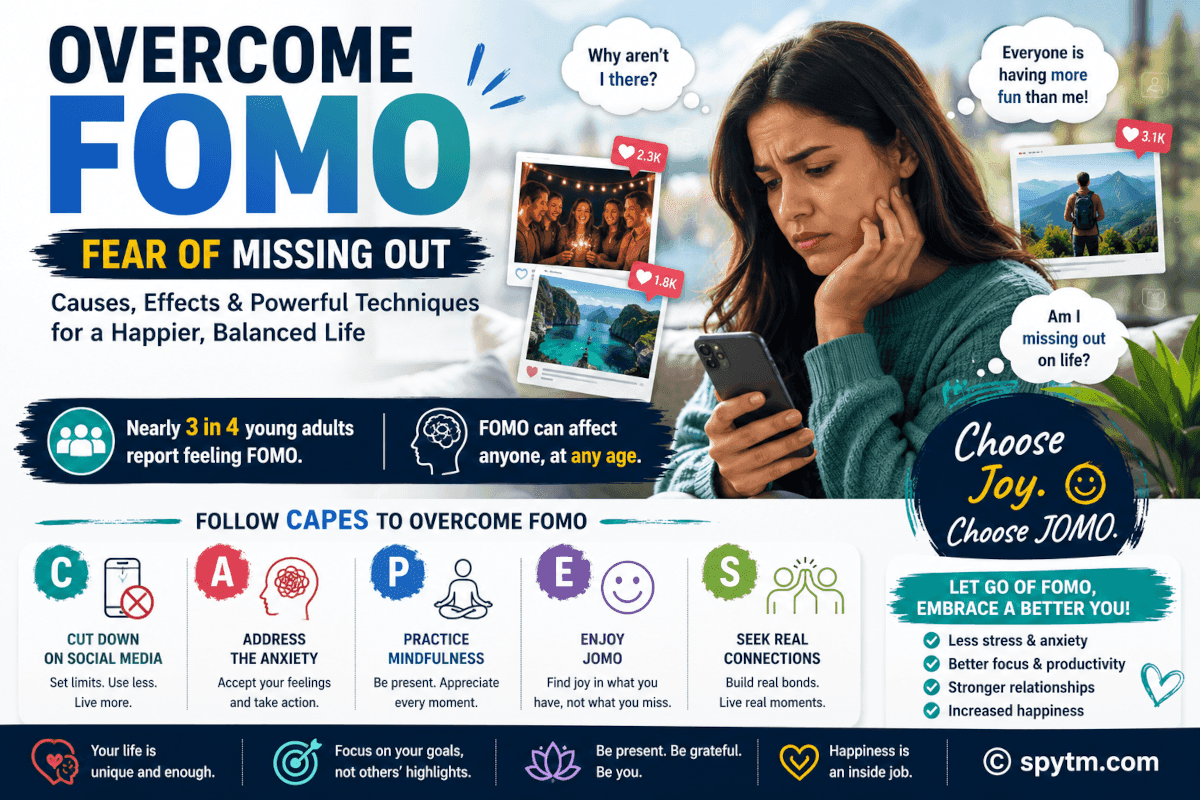
Follow CAPES to Overcome FOMO
A simple framework to remember is CAPES.
Cut Down on Social Media
Social media often acts as fuel for FOMO.
Why It Helps
Reducing exposure reduces opportunities for unhealthy comparison.
Practical Steps
Set Daily Limits
Limit social media usage to specific times.
Turn Off Notifications
Reduce unnecessary distractions.
Remove Unhelpful Accounts
Unfollow accounts that consistently trigger comparison.
Real-World Example
A person reduces Instagram usage from three hours to thirty minutes daily and notices lower anxiety levels within weeks.
Address the Anxiety
You cannot solve a problem you refuse to acknowledge.
Recognize Your Triggers
Ask yourself:
What content triggers FOMO?
Which platforms affect me most?
Which situations increase anxiety?
Challenge Negative Thoughts
Instead of thinking:
"Everyone has a better life."
Try:
"I'm only seeing a small part of their life."
Practice Mindfulness
Mindfulness teaches you to focus on the present moment.
Why It Works
FOMO often pulls attention toward what others are doing.
Mindfulness redirects attention to your own life.
Simple Mindfulness Exercise
While walking:
Notice your breathing.
Feel your footsteps.
Observe sounds around you.
Focus on the present moment.
Regular practice can reduce anxiety and increase satisfaction.
Enjoy JOMO (Joy of Missing Out)
JOMO is the opposite of FOMO.
Instead of fearing what you're missing, you appreciate what you're experiencing.
Examples of JOMO
Enjoying a quiet evening at home
Reading a good book
Spending time with family
Taking a break from social media
Benefits
Reduced stress
Better focus
Increased happiness
Improved mental health
Seek Real Connections
Online interactions cannot fully replace real-world relationships.
Build Meaningful Relationships
Spend time:
Meeting friends
Talking face-to-face
Attending local events
Participating in hobbies
Why It Helps
Real connections often provide greater satisfaction than virtual interactions.
Comparing FOMO Solutions
Method | Benefits | Challenges |
|---|---|---|
Social Media Limits | Reduces comparison | Requires discipline |
Mindfulness | Improves awareness | Takes practice |
JOMO Mindset | Increases happiness | Requires perspective shift |
Real-Life Connections | Improves relationships | Requires time |
Professional Support | Effective for severe cases | May involve cost |
Common Mistakes When Fighting FOMO
Trying to Quit Everything at Once
Gradual changes are often more sustainable.
Comparing Yourself to Everyone
No one can compete with millions of people online.
Seeking Constant Validation
Depending on likes and comments for happiness often increases FOMO.
Ignoring Real-Life Achievements
Many people overlook their own accomplishments while focusing on others.
Believing Social Media Reflects Reality
Remember that most people share highlights, not struggles.
Pros and Cons of Social Media
Pros | Cons |
|---|---|
Connects people | Encourages comparison |
Provides information | Can increase anxiety |
Supports networking | May reduce focus |
Offers entertainment | Can create FOMO |
Builds communities | May affect self-esteem |
When Should You Seek Professional Help?
Consider speaking with a mental health professional if FOMO:
Causes severe anxiety
Affects sleep
Damages relationships
Reduces work performance
Leads to depression
Interferes with daily life
Professional support can help develop healthier coping strategies.
Frequently Asked Questions
What does FOMO mean?
FOMO stands for Fear of Missing Out, a feeling that others are having better experiences or opportunities than you.
Is FOMO a mental illness?
No. FOMO is not classified as a mental illness, but it can contribute to anxiety, stress, and other mental health concerns.
Can social media cause FOMO?
Yes. Social media is one of the most common triggers because it encourages comparison.
What is JOMO?
JOMO stands for Joy of Missing Out. It involves appreciating your current experiences rather than worrying about what you're missing.
Who experiences FOMO the most?
FOMO can affect anyone, but it is often reported among young adults and frequent social media users.
Can FOMO affect productivity?
Yes. Constant checking of social media and worrying about missed opportunities can reduce concentration and efficiency.
How can I stop comparing myself to others?
Focus on your own goals, limit social media exposure, and practice gratitude and mindfulness.
Can therapy help with FOMO?
Yes. Therapy can help address underlying anxiety, self-esteem issues, and unhealthy comparison habits.
Final Thoughts
FOMO is a common experience in today's connected world, but it does not have to control your happiness. While social media and modern technology make it easier to compare yourself with others, it is important to remember that what you see online is rarely the complete picture.
Learning to recognize triggers, reducing unnecessary comparisons, practicing mindfulness, embracing JOMO, and building meaningful real-world connections can help you develop a healthier relationship with yourself and others.
The goal is not to experience everything. The goal is to appreciate the experiences you already have. When you focus less on what you're missing and more on what truly matters, life often becomes more satisfying, meaningful, and enjoyable.